Approach
Build it close enough to feel it.
I learn best when the abstraction has some exposed wiring. Several of these projects recreate
model components directly: patch embedding, positional encoding, layer normalisation,
attention blocks, decoders and training loops.
Practice
Training is an engineering problem
The repos include dataset handling, checkpoints, validation, experiment tracking, sweeps,
masking, inference scripts and the usual tensor-shape archaeology that separates a demo from
something you can reason about.
Range
Vision, language and sound
The course gave me a compact tour through modern AI systems: visual tokens, caption decoders,
audio features, speech recognition, image-to-DSL fine-tuning, embeddings and two-tower search.
What stuck
Systems around the model
The valuable habit was asking what the representation is, how the loss is being created, what
leakage or masking mistake might be hiding in the pipeline, and how to evaluate progress without
fooling myself.
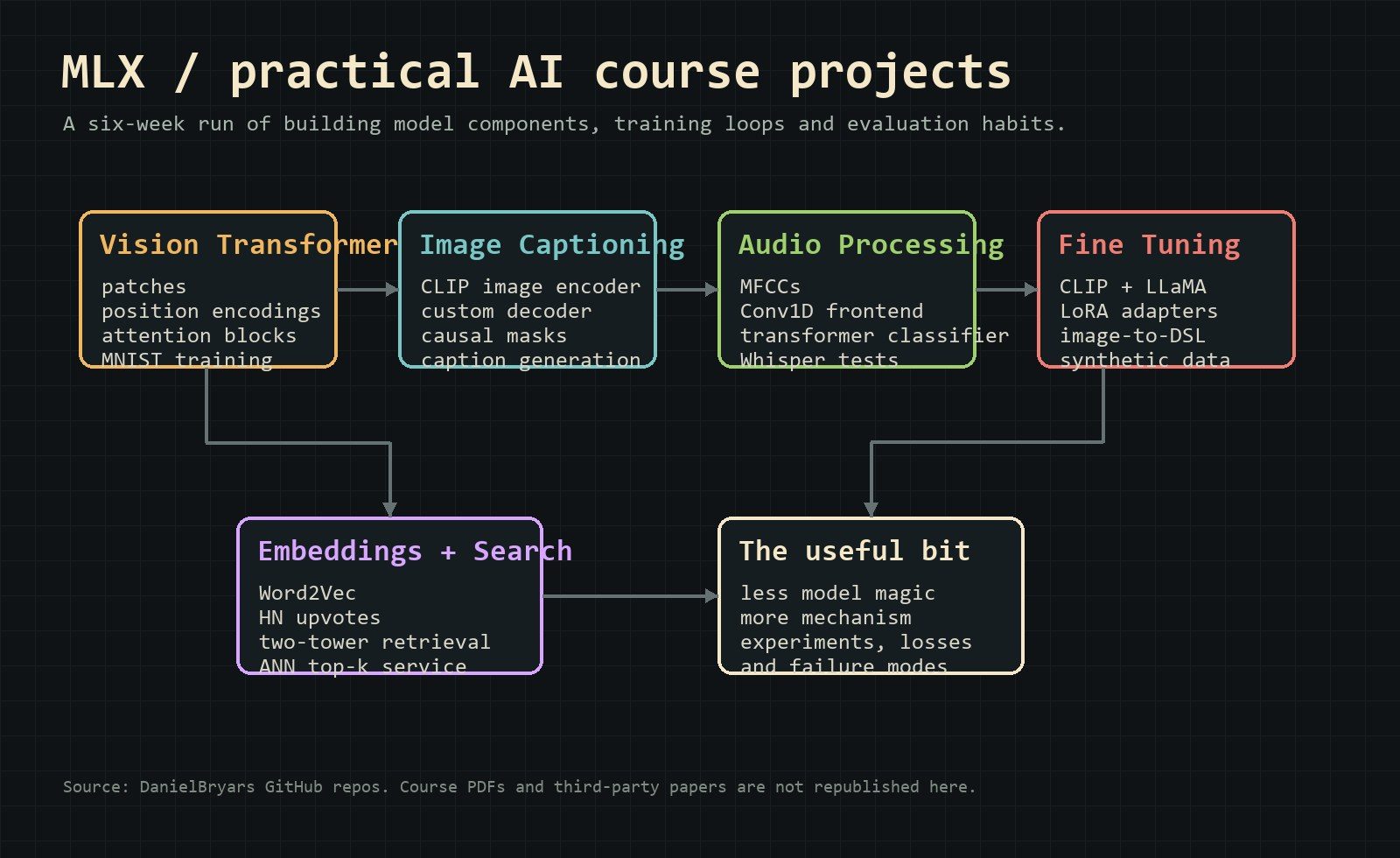
MLX3 / PyTorch / vision transformers
Implemented patch embedding, positional encoding, manual layer norm, self-attention, transformer blocks, classifier heads, MNIST training and WandB sweeps.
MLX4 / CLIP / decoder-only captioning
Built an image-captioning system with a frozen CLIP vision encoder, projection layer, custom transformer decoder and careful causal/image attention masking.
MLX5 / audio / transformers
Environmental sound classification with MFCC features, Conv1D frontends and transformer models, plus speech-recognition experiments with Whisper-style tooling.
MLX6 / LoRA / multimodal fine-tuning
Fine-tuned a LLaMA 3.1 8B workflow with CLIP visual features, a projection layer, LoRA adapters and synthetic diagrams rendered from a small custom DSL.
MLX7 / Word2Vec / prediction
Used a Word2Vec-style representation of Hacker News text as part of a supervised prediction task. A neat reminder that embeddings are features, not magic dust.
Embeddings / retrieval / service
Related retrieval work using document processing, Word2Vec embeddings, a two-tower model, approximate nearest-neighbour top-k search and a small FastAPI service.